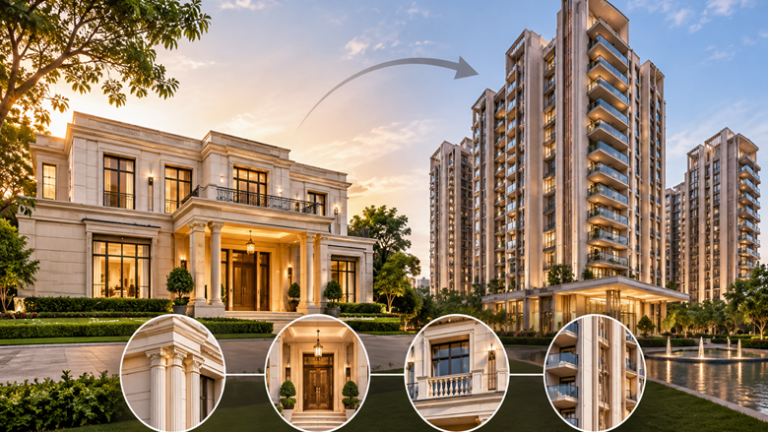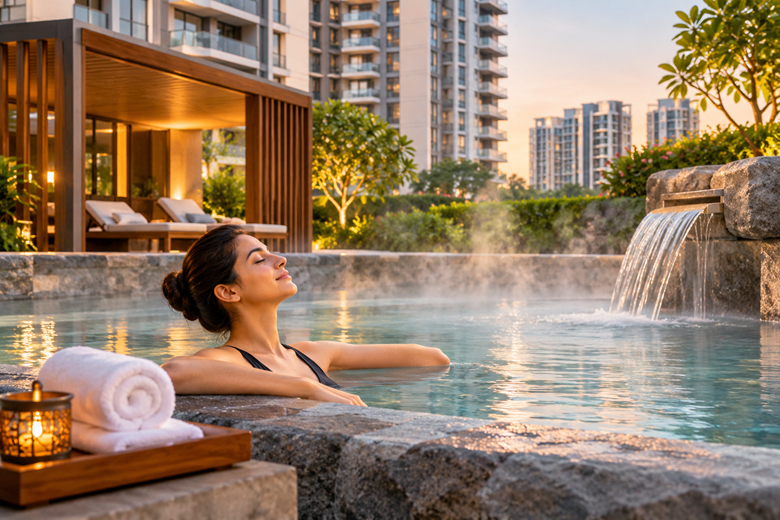
An Onsen pool is a warm soaking pool inspired by traditional Japanese hot spring baths, designed for relaxing in heated water rather than swimming laps. In Japan, it is valued as both a wellness practice and a social bathing custom. Understanding its Benefits and Safe Use in Gurgaon is particularly relevant during winter, when temperatures can drop significantly. At Godrej Sora Sector 53, Gurgaon, Godrej Properties lists an Onsen-style pool alongside a rooftop swimming pool, spa and squash court. The Japanese-themed residential project off Golf Course Road is registered under Haryana RERA number GGM/976/708/2025/79, with completion declared for September 2032. These amenities offer residents a Japanese-inspired relaxation experience during Gurgaon’s colder months, when temperatures fell to 0.6°C on 12 January 2026.
Onsen Meaning
In Japan, Onsen is a legal term. Under the Hot Springs Act, water qualifies when it emerges from the ground at 25 degrees Celsius or more at the source, or when it contains at least 1 of 19 listed substances above a set amount per kilogram.
A residential pool filled from a city supply cannot meet that test, so the accurate label in India is Onsen-style or Onsen-inspired. What the design borrows is the bathing culture, not the spring water.
Japan is now seeking global recognition for that culture. In November 2025, a government panel chose Onsen culture as a candidate for the UNESCO intangible cultural heritage list, with the nomination due by the end of March 2026 and a decision targeted for 2030.
Onsen Benefits Backed by Science
Claims about detox and skin repair are common online. The strongest long-term evidence is about the heart, and it supports the bath’s central place in Japanese wellness.
A Japanese study followed 30,076 adults aged 45 to 59 for about 20 years. A daily hot bath was linked with a 28 percent lower risk of cardiovascular disease and a 26 percent lower risk of stroke, compared with bathing once or twice a week or not at all.
The same study found no link with sudden cardiac death. Because it was observational, it cannot prove that bathing causes the benefit.
Onsen Temperature and How Long to Stay
Japanese bathing advice recommends keeping Onsen pool water below 41°C and limiting each session to 10 minutes. For Benefits and Safe Use in Gurgaon, warm the changing area before bathing to reduce heat shock when moving from cold air into hot water.
For shared hot tubs, health authorities set an upper limit of 40 degrees Celsius.
Onsen Hygiene and Water Testing
Warm water needs stronger disinfection than a regular pool. Guidance for shared hot tubs asks for free chlorine of at least 3 parts per million, or bromine of 4 to 8 parts per million, with pH between 7.0 and 7.8, checked at least twice a day and during peak use.
A strong chemical smell is a warning sign, not proof of cleanliness, because well-chlorinated water has little odour. Tiles around the water should not feel slippery or sticky.
Onsen Etiquette for First-Time Users
- Shower fully before you enter the water.
- Step in slowly and sit; the bath is for resting, not swimming or splashing.
- Skip alcohol before and during a soak.
- Do not swallow the water, and stay out if you have diarrhoea.
- Leave the water as soon as you feel dizzy or overheated.
Heated Swimming Pool in Winter in Gurgaon
Year-round swimming is still new for the city’s public facilities. The first government all-weather heated pool, a 50-metre, 8-lane facility at Kamla Nehru Park costing ₹12.5 crore, was about 80 percent complete in August 2026 and was scheduled for handover by December.
A clubhouse soaking pool serves a different purpose from a lap pool. It suits a short evening dip in the cold months, close to home, without booking a slot or crossing the city.
Godrej Sora Sector 53 Amenities: Shiki Clubhouse and Wellness Spaces
The Shiki Clubhouse at Godrej Sora takes its name from the Japanese word for the four seasons, with an architectural form inspired by traditional Japanese tiered roofs. Beyond its four distinct spaces, the clubhouse experience extends to a pool deck, gymnasium, badminton and multipurpose hall, rooftop leisure zones, sunken seating areas and dedicated kids’ play zones, bringing recreation, wellness and community living together.
The design follows Shibui, the Japanese idea of quiet, understated beauty, with Japanese flora in the landscaping and Hafeez Contractor as architect.
Some details buyers will want are not confirmed yet. Water temperature, pool size, and whether the pool is indoors have not been published, and online listings disagree on the clubhouse’s total area.
Pros and Cons of a Heated Soaking Pool
The clearest advantage is use in the cold months, when a regular pool is hard to enjoy. Soaking needs no swimming skill, so grandparents and non-swimmers can use the same facility as everyone else.
The costs are real. Heating water through a Gurgaon winter uses energy, and residents pay for it through maintenance charges. Warm water also needs closer chemical control, and possession is still years away, so this is a long-horizon benefit rather than an immediate one.
Questions to Ask About a Clubhouse Heated Pool
Buyers of premium homes on Golf Course Road already check balcony depth and lobby height, and the pool deserves the same attention. Ask for the target water temperature, the months it will be heated, whether it is enclosed, who tests the water and how often, and how heating costs are shared in the maintenance bill.
Written answers on these points tell you more about winter life in the clubhouse than any render.
“Judge a heated pool by its winter timetable, not by its brochure photograph.”
Key Takeaways for Godrej Sora Homebuyers
A heated soaking pool is worth judging on its winter performance, its water quality and its running cost, not on its name.
- The Japanese term has a legal meaning, and an Indian clubhouse version borrows the bathing culture rather than the spring.
- Long-term research supports regular warm bathing for heart health, within the limits of an observational study.
- Safe use depends on moderate temperature, brief sessions, and water tested throughout the day.
- For anyone weighing a Godrej Sora investment, the final pool specifications are worth tracking on as construction progresses.
For floor plans, the payment schedule or a site visit, you can call or WhatsApp +91 98111 82528.
Read more: https://www.godrejsora.org.in/blog/
Onsen FAQs
Is it okay to onsen every day?
Yes, for most healthy adults, a short daily bath is a normal habit in Japan, and long-term Japanese research has linked daily hot bathing with lower heart and stroke risk. You should keep each session brief and the water moderate. Older adults and anyone with a heart condition or high blood pressure should check with a doctor first.
Do you wear clothes in an onsen?
No, you enter a traditional Japanese onsen without swimwear; after washing at the shower stations, small towels stay out of the water. A residential onsen-style pool in India works differently, because you follow the clubhouse’s own dress code. Ask the facility team about the rules before your first visit to avoid surprises.
Why do I feel sick after an onsen?
Feeling dizzy, faint or sick after a hot bath usually means the water was too hot or you stayed in too long. Bathing accidents are taken seriously in Japan, where about 19,000 people die each year in bath-related incidents. Get out, sit down and drink water, and seek medical help if the symptoms do not settle.
Can young children use a heated soaking pool?
Keep children under 5 out of hot tubs and very warm pools, as public health guidance on warm-water bathing advises. Older children can join a brief dip with an adult beside them at all times. For splashing and active play, a regular pool and the kids’ play zones are the better places to spend time.
Is a heated pool safe during pregnancy?
You should talk to a healthcare provider before using a hot tub or any heated pool while pregnant. Your doctor can tell you what is safe for your stage of pregnancy and your health history. Until you have that clearance, gentle walks in landscaped gardens are a simpler way to stay active through the cold months.
Where is Godrej Sora located?
The project is on Plot GH-21 in Sector 53, Gurgaon, linked to Golf Course Road by an 18-metre road. You can reach the Sector 53-54 Rapid Metro Station in about 5 minutes, Cyber City in about 14 minutes and IGI Airport in about 20 minutes, though travel times depend on traffic at the hour you drive.
How many hot springs are there in Japan?
Japan counted 27,920 hot spring sources in its fiscal 2023 national survey. That density explains why Japanese wellness is so closely tied to bathing, since a natural spring is within reach for most people there. Outside Japan, an onsen-style pool recreates the soaking ritual with treated, heated water in place of a natural mineral source.